
Emergency Air Duct Cleaning Near Me: What East Nashville Homeowners Should Do First
After a house fire, running your HVAC system – even briefly – before duct cleaning can push soot particles into every room in a matter of minutes. The duct cleaner’s job starts with making sure that system stays off, not with booking a same-day slot. Emergency air duct cleaning near me in East Nashville is a question people ask at the worst possible moment, and the sequence of steps before any cleaning begins usually decides whether the job solves the problem or spreads contamination faster. If you’d rather not work through this alone, call (877) 417-5183.
We answer 24/7. Fast dispatch from 7am to 7pm, Sunday through Friday.
Key Takeaways
- Turn the HVAC system off before you call anyone – this is step one in every scenario below.
- The four real emergencies are post-fire smoke, post-flood moisture, rodent die-off inside ducts, and HVAC failure with debris backflow.
- Declaring an “emergency” doesn’t skip inspection. Cleaning comes after we know what’s in the ducts.
- Photograph and log duct condition before work starts. Your adjuster will need it.
- Cleaning alone isn’t enough when duct sections are damaged or compromised. Repair and sealing come first.
What Counts as an Emergency Air Duct Situation in East Nashville?
An emergency duct situation is one where contamination is actively moving, growing, or causing a health or fire risk right now – not where the ducts are merely dirty. East Nashville homes sit in a humid climate with long cooling seasons, and that changes what counts as urgent. Mold can colonize a damp duct interior faster than most homeowners expect. Here are the four scenarios we get called about.
- Post-fire smoke contamination. Soot and smoke residue settle in ductwork and can re-enter living spaces every time the system runs. This is the one where speed and sequence matter most.
- Post-flood moisture infiltration. Standing water or saturated insulation near ductwork creates a moist environment where microbial growth takes hold. The ducts themselves may have absorbed moisture.
- Rodent die-off inside ductwork. Animals get into duct runs through gaps and disconnected joints, and the smell becomes unmistakable. This is a health concern, not just an odor.
- Catastrophic HVAC failure with debris backflow. When a blower fails or a component breaks apart, debris can be pushed through supply runs into rooms.
Each one needs a different first move. Treating them all the same is how a small problem becomes an expensive one.
What Should You Do First in Each Scenario?
The first move in every case is to stop the system from circulating air – turn the thermostat to off, don’t just lower the setpoint. After that, the triage diverges by scenario.
- After a fire: Keep the HVAC off. Don’t run fans or a window unit to “air things out” until a professional has assessed the ducts. Call your insurer before calling a cleaner, and tell the dispatcher it’s a post-fire situation so the right equipment gets mobilized.
- After a flood: Shut off power to the HVAC at the breaker if water reached the equipment. Document everything with photos. Tell the dispatcher how high the water got and whether duct insulation was submerged.
- Rodent die-off: Don’t run the system to “flush the smell out” – that spreads it. Seal off the room with the strongest odor if you can, and tell the dispatcher you suspect animal intrusion so we can plan for containment and full duct inspection.
- HVAC failure with debris: Shut the system down immediately. Don’t restart it to see if the noise goes away. Tell the dispatcher what failed and whether you saw debris come out of registers.
In every scenario, the dispatcher needs to know: what happened, when, whether the system has run since, and whether anyone in the home has asthma or allergy concerns. That last one changes how we stage the job in an East Nashville home.
What Does “Emergency Cleaning” Actually Mean Operationally?
Emergency cleaning means the job is scheduled ahead of routine work and the equipment is staged for containment from the first minute. It does not mean corners get cut. Here’s how the actual mobilization works.
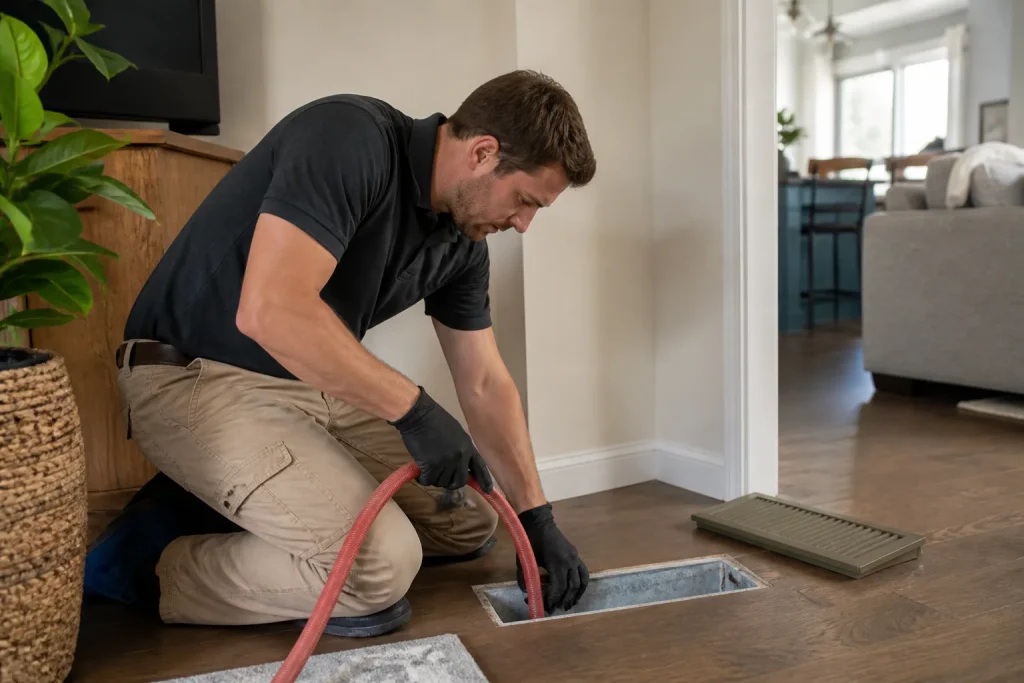
What moves fast: Air Duct Cleaning East Nashville brings negative-air filtration devices – Abatement Technologies units that pull contaminants out of the living space while the work is happening – on the first visit. Rotobrush rotary-brush systems agitate duct walls mechanically, and Nikro HEPA-rated vacuums contain what gets loosened. That combination is what makes a same-day or next-day response possible.
What takes staging time: jobs where duct sections are damaged, disconnected, or saturated. Those require inspection first and often repair before cleaning makes sense. If we clean a duct run that’s falling apart, we’re just moving debris from one place to another. Precise work beats fast work when the ducts themselves are the problem.
We answer 24/7. Fast dispatch from 7am to 7pm, Sunday through Friday.
How Do You Document Duct Damage for an Insurance Claim?
Photograph everything before a single brush goes into the ducts. Adjusters don’t need dramatic photos – they need consistent, dated, contextualized ones. Here’s what works.
- Photograph each supply and return register with a wide shot and a close-up.
- Photograph any visible soot, moisture, or debris at the register face.
- Photograph the air handler and any duct connections you can reach safely.
- Note the date and time of each photo in a simple written log.
- Get a written scope of work from whoever cleans the ducts – adjusters need to see what was cleaned, how, and with what equipment.
That written scope matters for the claim. A one-line invoice doesn’t tell an adjuster much. A document that names the equipment (Rotobrush, Nikro, Abatement Technologies containment) and describes the process is what gets claims approved. It’s also what protects you if a contractor disputes the work later.
If your insurer asks for documentation of indoor air quality components – for example, whether a Honeywell or Aprilaire filtration element was in the system – include that in your log too. It’s part of the picture.
When Is Cleaning Alone Not Enough?
Cleaning alone isn’t enough when the ductwork itself is compromised. That’s the scenario where experienced eyes on the system matter more than a fast brush.
Three signs mean you need more than cleaning:
- Disconnected or crushed duct runs. Sealing and repair come first. Cleaning a broken duct just redistributes what’s inside.
- Water-damaged duct insulation. Saturated insulation needs replacement – it will re-contaminate ducts after cleaning if it stays wet.
- Biological growth that returns. If microbial growth reappears after a clean, the source is moisture, and that means the HVAC system itself needs inspection.
This is where HVAC cleaning and duct repair cross over. Duct repair and sealing address the root causes of energy loss and re-contamination – not just surface-level debris. That’s the difference between a job that holds and one you repeat in a year.
For post-clean air quality work, we install and service Honeywell and Aprilaire components as a bridge between cleaning and true indoor air quality improvement. Not every job needs it. Some do.
When to Call a Pro in East Nashville
Call a pro when the situation is one of the four emergencies, when you suspect rodent intrusion or moisture in the ducts, or when the ducts have never been professionally serviced and you’re seeing symptoms now. Call sooner rather than later if anyone in the home has asthma or allergy concerns – the timing matters.
Call after a renovation that generated substantial dust, or after any event where you’re unsure whether the HVAC ran afterward. And if the ducts themselves may be damaged or disconnected, don’t book a cleaning – book an inspection.
For a related fire-risk service, dryer vent cleaning is worth scheduling alongside any duct appointment. Lint accumulation is a leading cause of residential house fires, and it’s a quick fix when it’s caught early.
Related services in East Nashville
If you’re dealing with a specific scenario from this article, our air duct cleaning page covers the standard process end to end, and our dryer vent page handles lint buildup separately.
The Bottom Line
Emergency air duct situations in East Nashville usually come down to sequence: shut the system off, document what you see, tell the dispatcher exactly what happened, and let the right equipment handle it. The four scenarios – post-fire smoke, post-flood moisture, rodent die-off, and HVAC failure with debris – each need a slightly different first move, but none of them are solved by running the system to “clear it out.” Our technicians have up to 13 years of experience on this kind of work, and the equipment on the job – Rotobrush, Nikro, Abatement Technologies – is purpose-built, not repurposed. If you’re in East Nashville and need help, Air Duct Cleaning East Nashville offers free estimates – call (877) 417-5183. We answer 24/7. Fast dispatch from 7am to 7pm, Sunday through Friday.
Frequently Asked Questions
Turn the HVAC system off immediately – don’t run it to test anything. Keep it off until a professional has assessed the ducts. Then call your insurer and call us. Running the system after a fire pushes soot into every room within minutes.
Yes, mechanical cleaning plus sanitizing usually resolves the odor. The catch is finding how the animals got in – duct repair and sealing close those entry points, and without that, the problem can come back. We inspect for gaps and disconnected joints as part of the job.
Photograph every register, the air handler, and any visible damage before cleaning. Note the date and time. Most importantly, get a written scope of work from whoever does the cleaning – adjusters want to see what was done and with what equipment. A one-line invoice doesn’t help the claim.
No – the price is set per job by a written estimate, agreed before work starts. Call (877) 417-5183 for an exact quote. Estimates are free.
Written by the team at Air Duct Cleaning East Nashville.
Need Air Duct Cleaning Help?
Call Air Duct Cleaning East Nashville - the local pro we connect you with is licensed and insured, with free written estimates in East Nashville.
(877) 417-5183