
Air Duct Cleaning: Repair or Replace? How East Nashville Homeowners Decide
Most homeowners ask us whether they should clean or replace their ductwork after they’ve already been quoted for something. That’s backwards. The right answer comes from inspecting the ducts, not from a price sheet. The genuine decision comes down to three conditions: surface contamination only, mechanical damage with the structure still intact, or structural failure and heavy moisture intrusion. Each one leads to a different path and a very different bill.
We’ll walk through how to tell which situation you’re in, what an inspection should reveal, and where the money genuinely goes over a five-year stretch in an East Nashville home. If you’d rather have someone look before you commit to anything, call (877) 417-5183 for a free estimate.
What are the three duct conditions that decide clean, repair, or replace?
Every duct system we assess in East Nashville falls into one of three buckets, and the bucket determines the service. Getting this wrong is expensive either way.
- Surface contamination only. The duct walls have dust, debris, or light microbial film, but the structure is sound. Joints hold, flex runs aren’t kinked or torn, and there’s no standing moisture. This is a cleaning job, plain and simple. Nothing needs replacing.
- Mechanical damage with intact structure. You’ve got disconnected joints, crushed flex sections, torn vapor barriers, or gaps at the plenum. The duct system is still usable but leaking. This calls for cleaning plus repair or sealing – the two go together for a reason we’ll get to.
- Structural failure or severe moisture intrusion. Collapsed runs, duct board that’s gone soft or moldy through its thickness, or flex duct soaked from a condensate problem. Cleaning won’t fix this. The affected sections get replaced.
The trick is that buckets two and three don’t always announce themselves. A register cover looks the same whether the run behind it is perfect or quietly leaking half its air into the attic. That’s why the inspection matters more than the quote.
Why does a camera scope change the conversation?
A camera scope reveals what a visual check at the register cannot: the inside of the trunk line, the condition of flex runs buried in the attic, and any moisture or pest evidence you’d never see otherwise. That’s the whole point of paying for an inspection before you commit to a service.
Pop the register off and shine a flashlight in, and you’ll see one thing – the last few feet of duct near the opening. In an East Nashville home with a crawlspace or an attic system, that’s a tiny slice of the actual ductwork. The dust you see at the register might be the only dust in the system, or it might be the tip of a much larger buildup sitting in the trunk line twenty feet back.
A camera scope answers two questions that decide everything:
- Is there actual debris accumulation in the system, or is it just normal surface dust?
- Are the joints, seams, and flex connections intact, or are they leaking and pulling in attic air?
An inspection with a scope usually runs in the range of a standard service call and often gets credited toward whatever service you book. It’s worth doing before you spend money on cleaning a system that’s going to need sealing anyway. Cleaning a leaking system just means you re-clean it later.
When does repairing aging flex duct cost more than replacing it in East Nashville?
Aging flex duct in East Nashville attics lives in a brutal environment: attic temperatures that swing from near-freezing winter nights to 130°F-plus summer afternoons, with high summer humidity on top. That cycling degrades the inner liner and vapor barrier faster than in milder climates. Repairing a single failed section is usually cheaper. Repairing three or more sections of an aging system usually isn’t.
Here’s a rough way to think about it. Every flex run has a typical service life. Once a duct system is past the point where the vapor barrier is degrading across multiple runs, every repair is chasing the next failure. You patch one tear, and six months later the liner on the next run cracks. Over five years, the cumulative repair bills on a near-end-of-life system climb past the cost of replacing the runs that keep failing.
Our rule of thumb: if more than roughly a third of the accessible flex runs need attention, replacement of those runs usually makes more long-term sense than repeated patching. Below that threshold, repair and seal. This is a judgment call, not a formula, and a good inspection gives you the information to make it.
How do you read a static pressure test, and why does it matter?
A static pressure test measures the resistance inside your duct system and tells you whether the real problem is leakage or debris. If the system is pulling too much negative pressure in the return, the house is drawing in attic air, crawlspace air, or outdoor air through every gap in the ductwork – and no amount of cleaning will fix that. Sealing will.
The test itself is straightforward. A technician drills a small test port into the supply plenum and another into the return plenum, then reads the pressures with a manometer. Most residential systems should land within a target range the manufacturer specifies, and if the return side is markedly negative, that’s the tell.
What you want to know from the results:
- Is total external static pressure higher than the system’s design range? That points to restricted airflow – could be a dirty filter, a crushed duct, or a coil issue.
- Is the return side strongly negative? That’s duct leakage pulling in unfiltered air from unconditioned spaces.
- Is the supply side unusually low? That’s leakage bleeding conditioned air out before it reaches the rooms.
If you’ve been told your ducts are dirty but your static pressure readings are off, ask for the test results. A system that only needs cleaning will usually read close to normal on static pressure. A system with significant leakage will read otherwise, no matter how clean the ducts are.
What does duct sealing actually involve, and does the order matter?
Duct sealing closes the gaps and joints that leak conditioned air. There are three main approaches in residential use: mastic, foil tape, and aerosol-based sealing systems like Aeroseal. Each works on different parts of the problem, and the sequence – sealing before cleaning versus after – changes the final result.
Mastic is a brush-applied sealant used on accessible joints, plenum seams, and connections. It’s durable and standard for visible duct connections.
Foil tape (not cloth duct tape, which fails in attic heat) seals accessible joints where mastic isn’t practical. It’s fast but requires proper surface prep to hold long-term.
Aeroseal is an aerosol-based process that seals leaks from the inside of the duct system by circulating a fog of sealant particles that accumulate at leak sites. It’s used where accessible sealing can’t reach – inside wall chases, under floors, and long trunk runs.
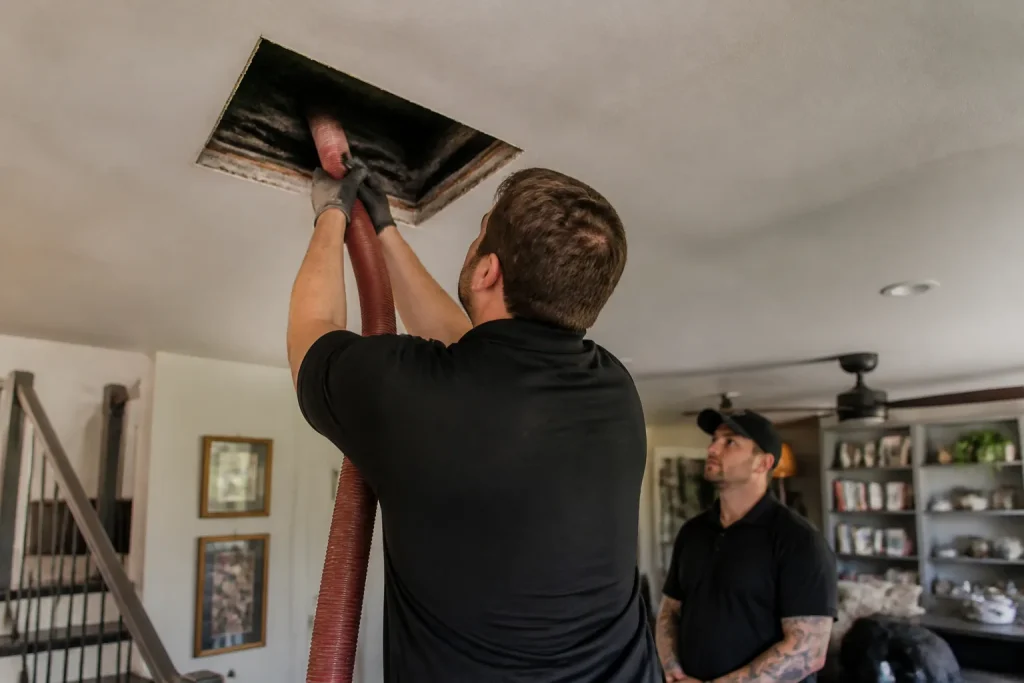
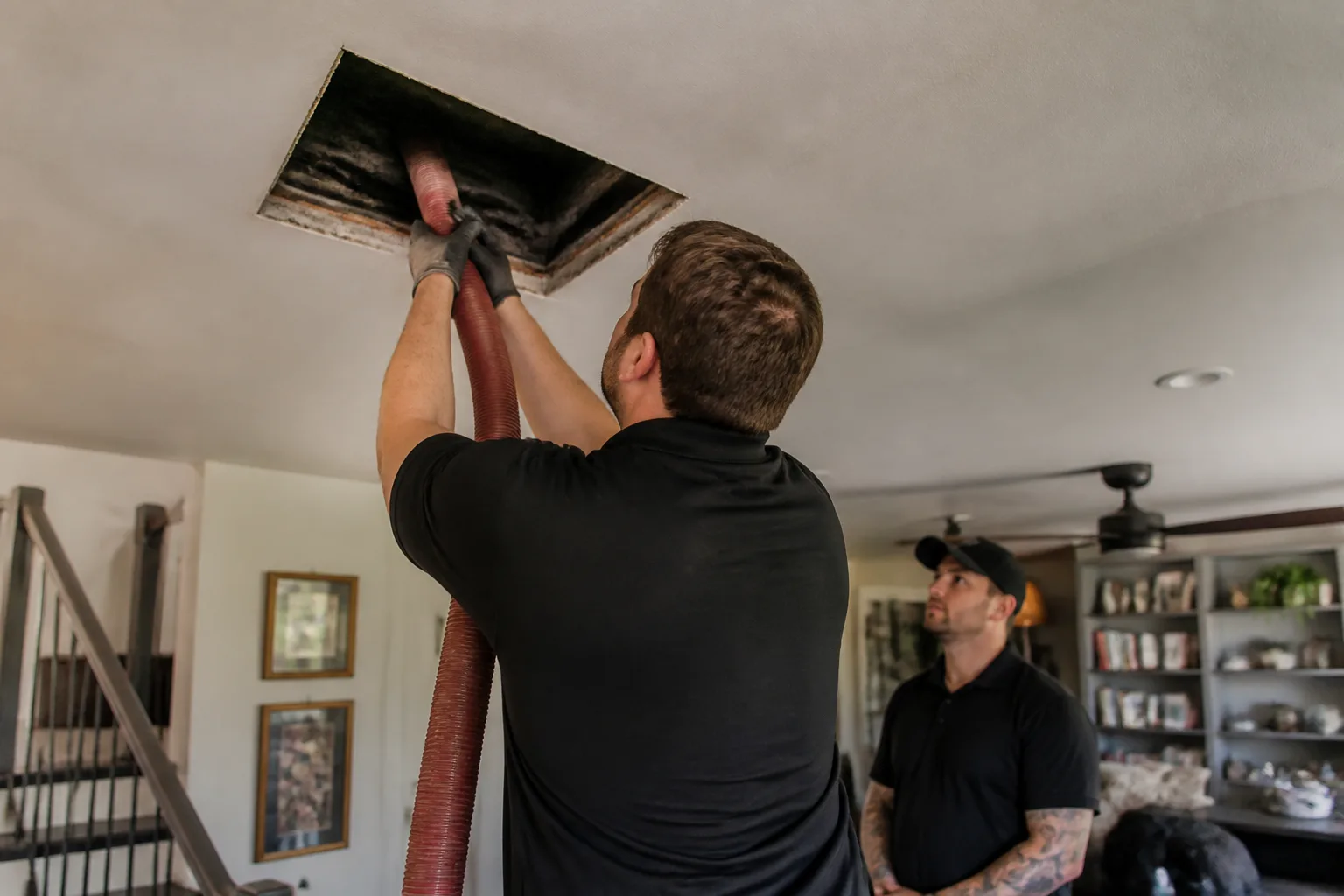
Order matters because sealing first on a contaminated system traps debris inside the sealed sections. Our approach is to clean first with a Rotobrush rotary-brush system to agitate and remove debris, then seal the system. That way the sealant bonds to clean duct walls and the debris is already gone. Seal first and clean later, and you’ve locked in the problem. A Nikro HEPA vacuum handles the extraction side, and during the job we use Abatement Technologies negative-air filtration to keep the living space protected.
This is also where air duct cleaning and sealing stop being separate services and start being one job done in the right order.
When should you call a pro instead of assessing it yourself?
Some of this you can check yourself. If a register is loose, you can tighten it. If a flex run in an accessible attic is visibly disconnected, you can see the problem. But the decisions that actually cost money – scope inspection, static pressure testing, deciding whether to seal or replace – belong in the hands of someone with the tools to do them accurately.
Call a pro if any of these apply:
- You’ve had a recent HVAC repair and the system still doesn’t cool or heat evenly.
- You notice musty odors from registers or visible moisture anywhere in the ductwork.
- You’ve got a home built or renovated more than fifteen years ago and the ducts have never been professionally serviced.
- Your energy bills have climbed without a clear cause.
- A previous contractor recommended cleaning without showing you what they found.
The last one is worth pausing on. No scope, no static pressure test, no before-and-after photos – that’s not a diagnosis, it’s a sales pitch. Our technicians have up to 13 years of experience, and we’ll show you what we find on a scope before recommending anything.
Related services in East Nashville: if your assessment points toward the HVAC side, we also handle HVAC cleaning as part of the same system. And if you’ve never had your dryer vent looked at, that’s a separate fire-risk question worth addressing – dryer vent cleaning covers it.
How much does air duct cleaning or repair typically cost in East Nashville?
Air duct cleaning in East Nashville typically runs several hundred dollars for a whole-home system, and repair or sealing ranges upward depending on how many sections need attention. Replacement of failed runs costs more still. The written estimate sets the final price, and there are no per-vent charges.
| Service | Typical Range (Estimate) |
|---|---|
| Camera scope inspection | Standard service-call range, often credited toward service |
| Whole-home air duct cleaning | Several hundred dollars, system size dependent |
| Duct repair and sealing (per section) | Modest add-on to cleaning, varies by access |
| Full aerosol sealing | Higher, priced by system size and leak severity |
| Replacement of failed flex runs | Priced per run, by access difficulty |
One flat price per system, agreed before work starts, is the standard we hold ourselves to. No per-vent pricing, no surprise line items once the technician is on site. If your previous quote was a low teaser number, ask what it actually covers – duct cleaning is one of those trades where the cheap quote is often the most expensive outcome.
The Bottom Line
Cleaning a system that needs sealing wastes money. Replacing ductwork that only needed cleaning wastes more. The order that actually works is inspect, then clean if warranted, then seal.
- Surface contamination only: clean.
- Mechanical damage, structure intact: clean plus seal or repair.
- Structural failure or heavy moisture: replace the affected section.
- Aging flex duct past a third of the runs failing: replacement usually wins over five years in East Nashville’s attic heat.
- Static pressure and scope results tell you which bucket you’re in. The quote tells you nothing.
If you’re in East Nashville and need help, Air Duct Cleaning East Nashville offers free estimates – call (877) 417-5183. We answer 24/7. Fast dispatch from 7am to 7pm, Sunday through Friday.
Frequently Asked Questions
Whole-home air duct cleaning in East Nashville typically runs several hundred dollars, with repair or sealing adding to that depending on how many sections need attention. The written estimate you receive sets the final price, and there are no per-vent charges. Call (877) 417-5183 for an exact quote – estimates are free.
Cheap quotes are usually per-vent teaser pricing that grows once the technician is on site, or they skip the mechanical agitation and extraction equipment a real clean requires. Our standard is one flat price per system, agreed before work starts, with before-and-after photos of your own ducts. Call (877) 417-5183 to see how that pricing works for your home.
Ask for a scope inspection before and after the job, plus before-and-after photos of your own ductwork. Anyone who won’t show you what’s inside the system before recommending a service isn’t diagnosing – they’re guessing. Call (877) 417-5183 and we’ll walk you through what we found.
Cleaning comes first, then sealing. Sealing a contaminated system traps debris inside the sealed sections, and sealant doesn’t bond well to dirty duct walls. Clean, then seal, then verify with a static pressure test. Call (877) 417-5183 for a free estimate on both.
Written by the team at Air Duct Cleaning East Nashville.
Need Air Duct Cleaning Help?
Call Air Duct Cleaning East Nashville - the local pro we connect you with is licensed and insured, with free written estimates in East Nashville.
(877) 417-5183